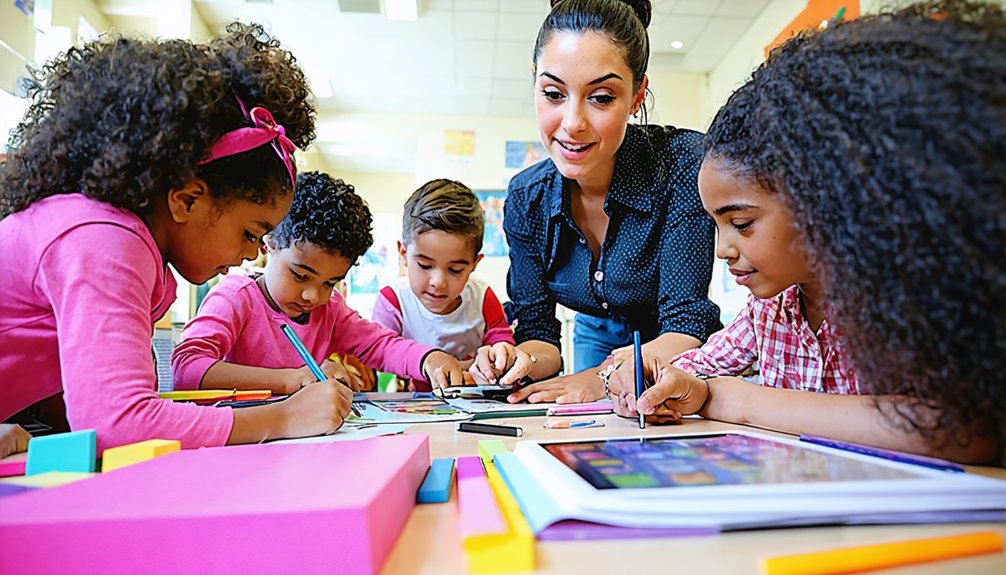

Special education programs prioritize inclusive teaching skills to support diverse student needs. These skills enable teachers to create adaptive learning environments. Effective programs incorporate collaborative planning, differentiated instruction, and technology integration. By developing inclusive teaching skills, educators can nurture academic success and social growth for all students. Exploring these programs further reveals innovative strategies for promoting inclusive education.
What Makes Inclusive Teaching Skills Essential For Special Education
How effectively can special education programs cater to diverse student needs without inclusive teaching skills. Inclusive teaching skills are essential for special education as they enable teachers to support diverse learners.
Teacher collaboration is essential, as it allows general and special educators to work together to develop individualized plans.
Policy compliance, such as adherence to IDEA and ESEA, also requires inclusive practices.
By incorporating these elements, special education programs can provide high-quality education that meets the unique needs of all students, promoting a sense of belonging and academic success.
Effective teacher collaboration and policy compliance are essential components.
Special education programs should prioritize adaptability to ensure that teachers can adjust their instructional methods to meet the changing needs of their students.
The use of UDL principles can help teachers design lessons that cater to different learning styles, allowing students to access the curriculum in a way that is meaningful to them.
How To Develop Inclusive Teaching Strategies For Diverse Classrooms
Developing inclusive teaching strategies is essential for creating diverse classrooms where all students can thrive. To achieve this, educators can use techniques such as evaluating classroom needs and climate, encouraging a positive social climate, and adapting instructional strategies with differentiation. Curriculum Mapping can help identify areas where inclusion can be improved. Additionally, Policy Advocacy can promote systemic changes to support inclusive teaching. By implementing these strategies, educators can create a welcoming environment that values diversity and promotes belonging, allowing all students to reach their full potential. This approach supports the development of inclusive teaching skills. Effective educators also use storytelling to connect with students and make learning more engaging, which can lead to better academic outcomes and increased student participation. Incorporating assistive technology into the classroom can further enhance the learning experience for students with diverse needs, promoting a more inclusive and supportive educational environment. Research has shown that using microaggressions awareness can help educators recognize and address unintentional biases in the classroom, ultimately leading to a more inclusive learning environment.
Understanding The Benefits Of Inclusion For Students With Disabilities
Numerous studies have demonstrated that inclusive educational settings yield substantial benefits for students with disabilities. These benefits include academic achievement gains, socioemotional development, and behavioral improvements.
Inclusive settings cultivate equity outcomes by promoting self-determination and positive perceptions of belonging.
The policy implications of these findings are significant, as they suggest that inclusive education can lead to better post-secondary, employment, and independent living rates. Research has shown that IDEA guarantees support for students with disabilities, which is a crucial factor in creating an inclusive environment that fosters growth and development for all students.
In addition to these benefits, it is essential to recognize that disability awareness and acceptance are critical components of an inclusive educational setting, as they allow teachers to provide tailored support and accommodations to meet the unique needs of their students.
Moreover, the fact that 95 % of students with disabilities are enrolled in regular schools, with a significant percentage spending most of their time in general classes, highlights the importance of inclusive teaching practices in these settings.
Creating A Supportive Learning Environment For Special Needs Students
The benefits of inclusive educational settings for students with disabilities are well-documented, and a key factor in realizing these benefits is the creation of a supportive learning environment. This environment is nurtured through peerotional scaffolding, where students support each other’s learning. Peer mentorship also plays an essential role, as students without disabilities learn to adjust their interactions to meet the needs of their peers with disabilities. The implementation of inclusive educational settings is often hindered by cost barriers, which can limit the availability of resources and support for students with disabilities. Currently, the number of students with disabilities is around 7.3 million, and this growing population underscores the need for more inclusive educational programs.
Effective Methods For Differentiating Instruction In Inclusive Classrooms
How effectively can instructors tailor their teaching methods to meet the diverse needs of students in inclusive classrooms?
Instructors can differentiate instruction through various methods.
Curriculum compacting allows teachers to tailor content to individual student levels.
Interest centers also facilitate differentiation, catering to diverse learning styles and strengths.
By incorporating these strategies, teachers can create a more inclusive learning environment, promoting educational equity and student engagement.
Effective differentiation enables instructors to address the unique needs of each student, cultivating a sense of belonging and supporting academic success.
This approach enhances student outcomes and overall classroom inclusivity.
Building Strong Relationships With Parents And Guardians Of Students With Disabilities
Most educators recognize that building strong relationships with parents and guardians of students with disabilities is essential for nurturing a supportive learning environment.
Establishing regular communication channels and trust building are essential components of parent partnership. This involves honest updates, empathy, and consistent follow‑through on commitments.
By acknowledging parent proficiency and using “we” language, educators can encourage a collaborative atmosphere. Trust building is also facilitated through transparent communication, active listening, and joint problem‑solving.
Effective parent partnership requires a willingness to lead with curiosity and employ culturally responsive approaches, ultimately strengthening the bond between educators and families.
Implementing Technology To Enhance Inclusive Teaching Practices In Special Education
Educators are leveraging technology to revolutionize special education, creating more inclusive and effective learning environments. They employ AI personalization to provide customized instruction, addressing diverse learning needs.
Mixed reality integration also enhances engagement, offering immersive experiences that encourage social interaction and autonomy. This approach supports students with disabilities, promoting academic performance and motivation.
By embracing technology, educators can create adaptive and accessible learning spaces, ultimately bridging learning gaps and supporting inclusive practices.
Effective technology integration enables educators to cater to individual needs, making special education more effective and inclusive. This leads to better outcomes for students.
References
- https://urbanedjournal.gse.upenn.edu/archive/volume-20-issue-1-fall-2022/inclusion-census-how-do-inclusion-rates-american-public-schools
- https://www.pewresearch.org/short-reads/2023/07/24/what-federal-education-data-shows-about-students-with-disabilities-in-the-us/
- https://nces.ed.gov/fastfacts/display.asp?id=59
- https://education.virginia.edu/news-stories/diversifying-special-education-teacher-workforce-could-benefit-us-schools
- https://ldaamerica.org/how-the-special-education-teacher-shortage-affects-students-with-ld-and-what-to-do-about-it/
- https://ncld.org/wp-content/uploads/2025/09/2020-Significant-Disproportionality-in-Special-Education.pdf
- https://hechingerreport.org/proof-points-special-education-inclusion-research-flawed/
- https://www.eclre.org/wp-content/uploads/2023/12/Inclusive-Education-2-pager-fast-facts1.pdf
- https://nces.ed.gov/programs/coe/indicator/llf
- https://www.indwes.edu/articles/2025/07/skills-for-special-education-teacher-success